
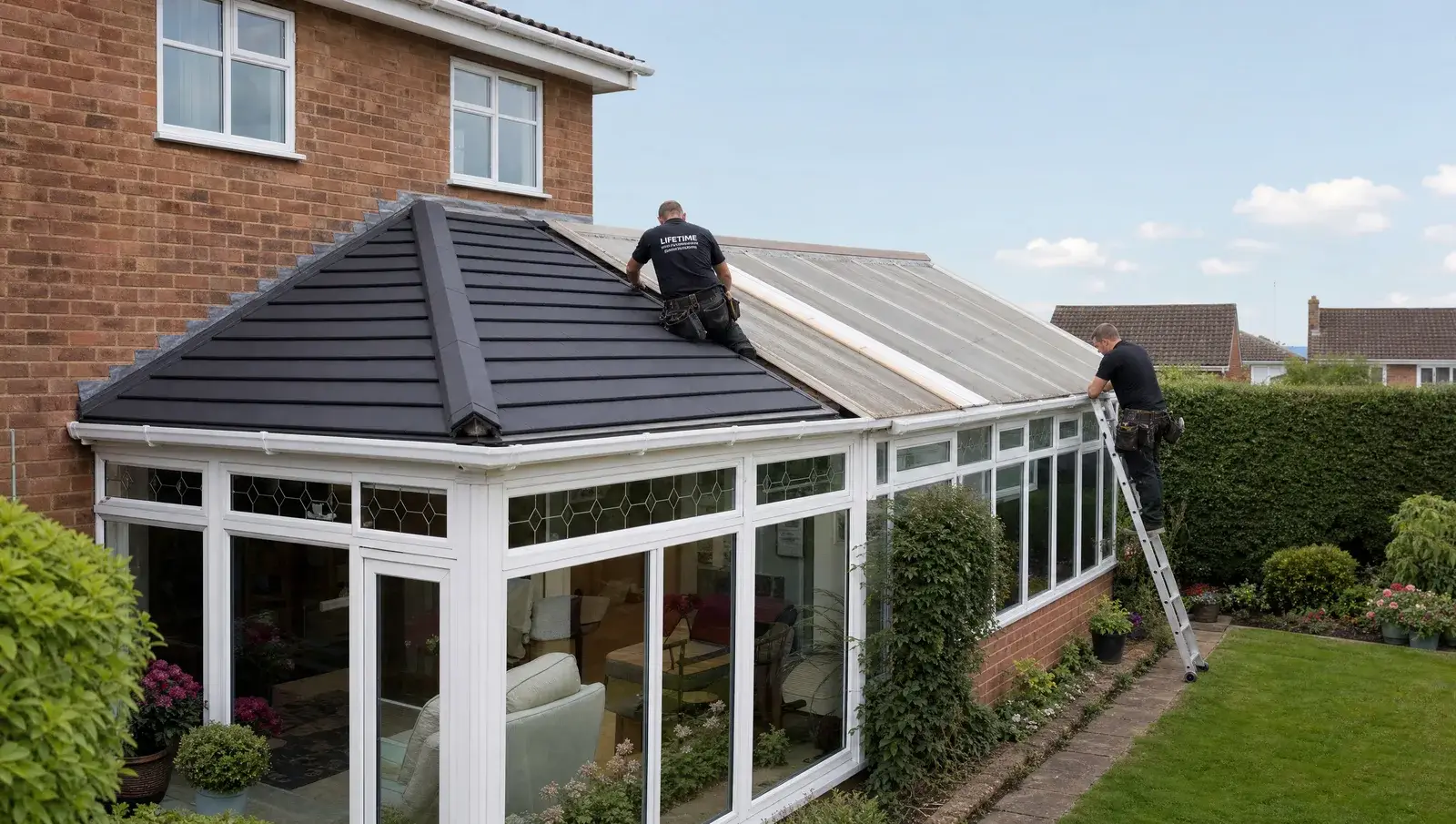
How much does a conservatory roof replacement cost?
Real 2026 prices for glass, solid insulated panel and lightweight tiled conservatory roofs, plus the building regs rules explained. Prices updated July 2026.
The system you choose moves the price far more than the size of the conservatory does, so the first decision is what you want the room to be: a brighter version of what you have, or a proper extension of the house. This guide covers the 2026 prices for each route, the building regulations point most homeowners miss, and what pushes a quote up. For a figure tailored to your own home, try the roof cost calculator.
Conservatory roof replacement cost by system (2026)
| Replacement system | Typical cost (fitted) |
|---|---|
| Like-for-like polycarbonate panels | £1,500 – £3,500 |
| Glass roof replacement | £4,000 – £7,500 |
| Solid insulated panel roof | £5,000 – £12,000 |
| Lightweight tiled solid roof | £7,500 – £16,000 |
| Per m² guide | Glass £350 – £550 · solid/tiled £500 – £1,000 |
New polycarbonate is the cheap fix, but it only resets the clock on the same problems. Most of the market has moved to glass or solid systems, and once you see why, the price gap makes sense.
Why people upgrade from polycarbonate
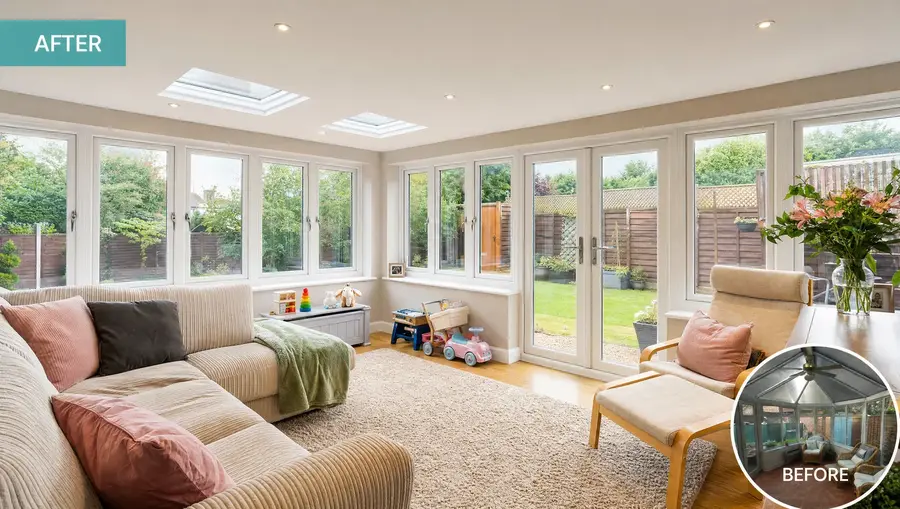
Polycarbonate conservatory roofs have a well-earned reputation: freezing in winter, an oven in summer, and noisy enough in rain that conversation stops. The result is a room most families abandon for half the year. A solid insulated roof changes the physics entirely, holding heat in winter, blocking solar gain in summer and deadening rain noise, which turns the conservatory into a genuine year-round space. That is why the conservatory roof replacement market has shifted so decisively towards solid and tiled systems, even at two or three times the price of new polycarbonate.
The building regulations point
A solid conservatory roof needs building regulations approval covering two things: the structure, because you are adding weight the original frames were never asked to carry, and thermal performance, because a solid roof changes how the room is classified. Every reputable installer starts with a frame survey to confirm the existing frames and foundations can take the load. Lightweight tile systems exist precisely for this reason: they deliver a tiled look and full insulation at a fraction of the weight of real tiles. The building regulations guide covers what the sign-off involves and who arranges it.
What drives the price
- Size: the per-m² rates above scale directly, so a large conservatory can cost double a compact one on the same system.
- Shape: Victorian and P-shape conservatories cost more than a simple lean-to because faceted and multi-pitch roofs mean more cuts, more frames and more labour.
- Glazing spec: on glass roofs, solar-control and self-cleaning glass add meaningfully to the price but fix the summer-overheating problem.
- Internal finish: a full plastered ceiling with spotlights turns the room into a proper extension, and adds £1,000 to £2,500 over a basic internal finish.
Get every quote itemised across those four lines and the comparisons become easy. When you are ready for real numbers, get free quotes from vetted local installers.
How a conservatory roof replacement works
The frames and the base stay where they are. A conservatory roof replacement strips off the existing glazing or panels, checks the frames can carry the new load, then builds the replacement roof onto the structure you already have. That is why it costs a fraction of a new conservatory, and why it is a 2 to 5 day job rather than a project.
The order of work is the same whichever system you choose. Frame survey first, then building regulations sign-off arranged, then the strip-out, then the new roof structure, insulation and covering, and last the internal ceiling with any spotlights or vents. If an installer wants to start before the frame survey, that is the moment to stop and get someone else in.
Conservatory roof cost by size
Conservatories come in a handful of standard sizes, and the roof is priced by area plus the complexity of the frame it sits on.
| Conservatory | Roof area | Glass | Solid insulated panel | Lightweight tiled |
|---|---|---|---|---|
| Small lean-to, 3 x 3m | 9 – 11m² | £3,500 – £5,500 | £4,500 – £8,000 | £6,000 – £10,000 |
| Standard, 3.5 x 4m | 14 – 16m² | £4,500 – £7,500 | £5,500 – £10,000 | £7,500 – £13,000 |
| Large, 4 x 5m | 20 – 24m² | £6,000 – £9,500 | £8,000 – £13,000 | £10,000 – £16,000 |
| Victorian or P-shape | Varies | Add 10 – 20% | Add 10 – 20% | Add 15 – 25% |
Shaped roofs cost more because every hip and facet is cut and sealed individually. A square lean-to is the cheapest shape to re-roof by a clear margin.
Polycarbonate to tiled: what you are actually paying for
The tiles are a small part of it. On a £9,000 lightweight tiled roof, the money goes on:
- The structural check, £300 to £600. A solid roof is three to five times the weight of polycarbonate. The existing frame and base either take it or they do not, and that is surveyed before anything is ordered.
- The new roof structure. Engineered timber or an aluminium frame system, sized for the load.
- Insulation and the internal ceiling. Plasterboard, skim and usually spotlights, which is what turns it from a conservatory into a room you use in February.
- Building control sign-off, £150 to £400. Swapping a glazed roof for a solid one is notifiable work. Reputable installers handle it and give you the certificate.
If a quote has no structural survey line and no building control line, it is not cheaper, it is incomplete.
How long does it take?
A glass replacement is one to two days. A solid insulated panel roof is two to three. A lightweight tiled roof with a plastered ceiling is three to five days, and the plaster needs a week to dry before it is decorated. The conservatory is open to the weather for part of day one, so the forecast matters.
Get real prices for your conservatory roof
Up to three itemised quotes from vetted local installers, checked against the fair rates on this page. Free, no obligation.