
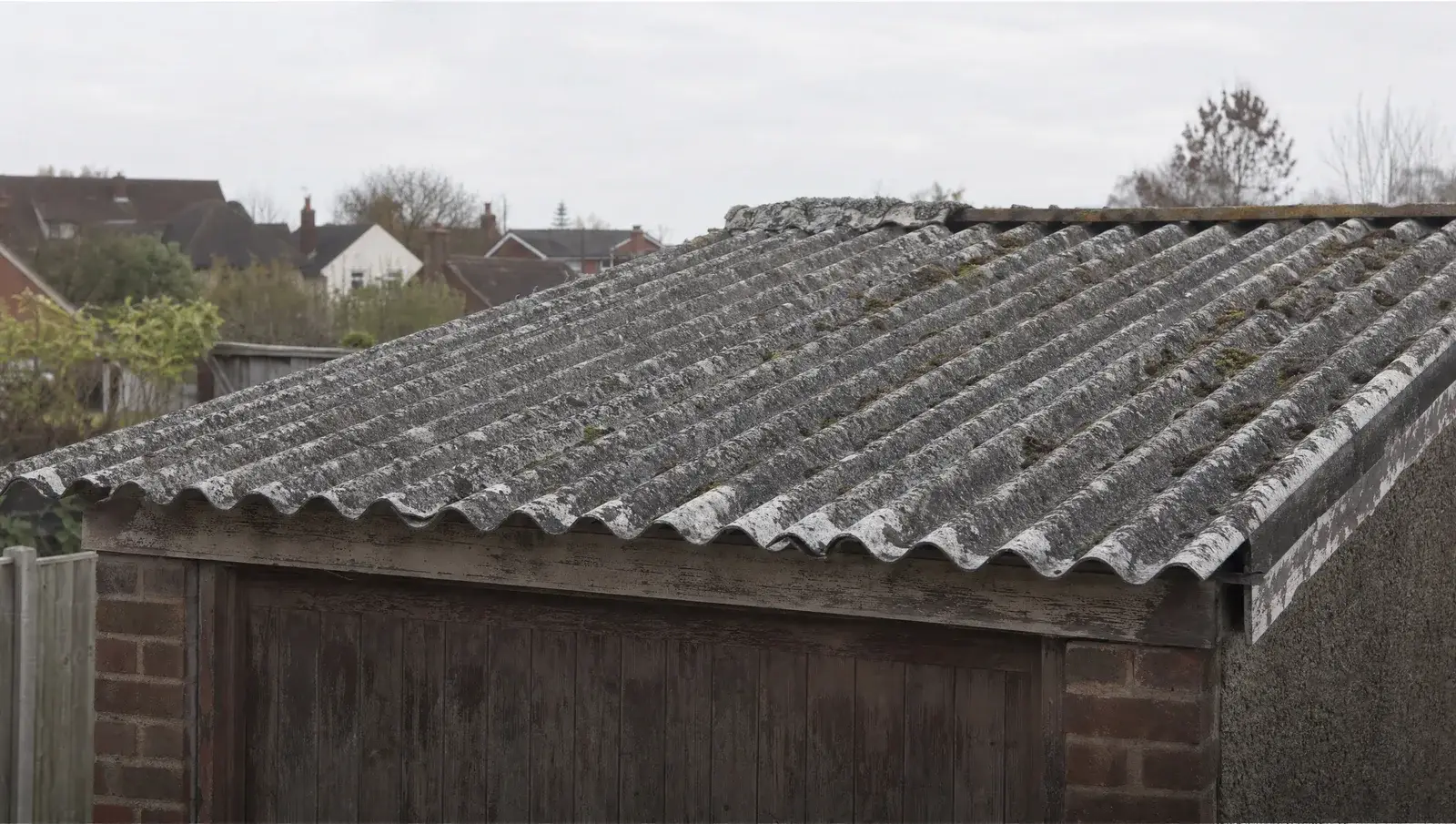
Asbestos roofs: what you can and can't do
Millions of UK garages and outbuildings still wear asbestos cement roofs. Intact, they are low risk. Handled wrongly, they are not. Here are the rules.
Where you'll find it
Asbestos cement was the standard budget roofing of mid-century Britain, so it turns up on corrugated garage and outbuilding roofs built before the 1990s, on lean-tos, sheds and workshops, and occasionally in older soffit boards and guttering. Asbestos was banned fully in the UK in 1999. If your corrugated grey cement roof predates the 1990s, work on the assumption it contains asbestos until a test says otherwise; you cannot tell by looking.
The golden rules
- Never break, drill, cut, sand or jet-wash it. The fibres are bound safely into the cement until something disturbs them. Jet washing is the classic accidental release: it strips the surface and puts fibres into the spray.
- Intact means low risk. A sound, undisturbed sheet quietly doing its job is not an emergency. Do not let anyone door-knocking tell you otherwise.
- Test before any work. A laboratory test on a safely taken sample settles the question for a modest fee, and any competent contractor will arrange it before quoting.
Repair and encapsulate, or remove?
Leave or encapsulate when the sheets are sound: an encapsulating coating seals the surface and extends its life, and minor fixings can be handled without disturbing the material. This is the cheapest and often the most sensible route for a roof with years left in it. Removal and replacement is the right call when sheets are cracked, the roof leaks, or you are re-roofing anyway. Asbestos cement removal is classed as lower-risk, non-licensed work under the control regulations, but non-licensed does not mean uncontrolled: sheets must come off whole where possible, damped down, double-wrapped and taken to a disposal site licensed for asbestos. Our garage roof service covers the full strip-and-replace, and the garage roof cost guide breaks down the 2026 prices for each replacement covering.
Disposal rules
Asbestos never goes in household waste, a skip or the regular tip. It must be double-bagged or wrapped in heavy polythene and taken to a collection point or transfer station licensed to accept it; many councils run householder schemes for small quantities, some free and some charged. Contractors handle this within the job, with waste consignment paperwork you can keep, which is a large part of what the asbestos premium pays for.
Living safely with what you keep
- Check the roof visually each year from the ground; leave the ladder in the shed.
- Keep moss removal to gentle treatment, never scraping or pressure washing.
- Tell any tradesperson working near the roof what it is before they start.
- Keep a note of the test result with your house papers; it helps at resale.
Get the asbestos handled properly
Up to three itemised quotes from vetted local roofers who test, strip and dispose by the book. Free, no obligation.