
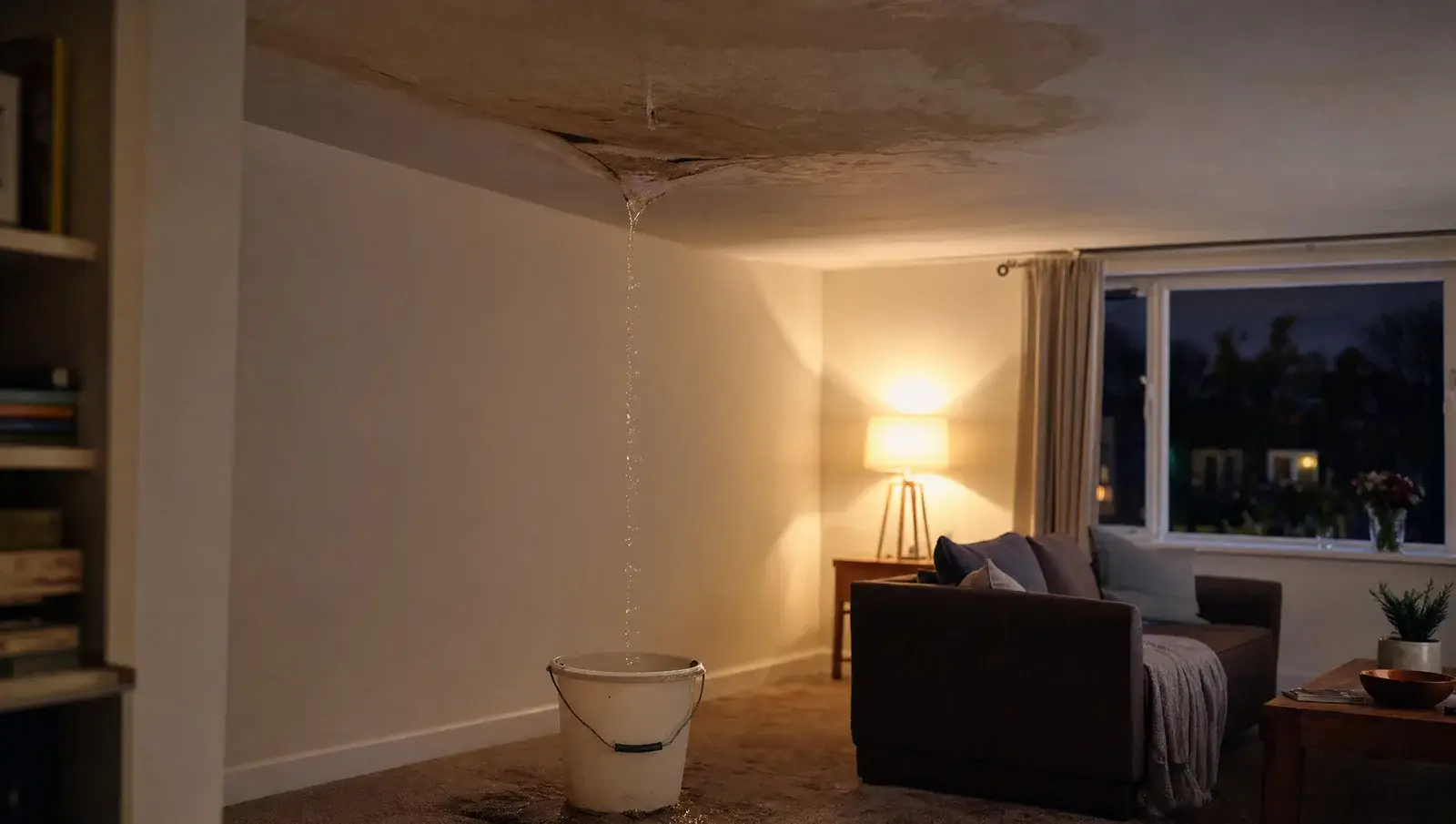
Leaking roof: what to do right now
The next ten minutes matter more than the next ten days. Here is exactly what to do, in order, then what the fix should cost.
Do these six things, in this order
- Catch the water. Put the biggest container you have under the drip. Drop an old towel or a sheet in the bottom so the drips do not splash out onto the floor.
- Protect the floor and furniture. Move furniture, electronics and rugs out of the drip zone. Cover anything you cannot move with plastic sheeting or bin bags. Water damage to contents often costs more than the roof repair itself.
- Release a bulging ceiling. If the plasterboard is bellying downwards, water is pooling above it. Put a bucket underneath, then pierce the lowest point of the bulge with a screwdriver and let it drain in a controlled way. A small hole is a patch repair; a collapsed ceiling is a new ceiling.
- Kill the electrics to affected fittings. If water is anywhere near a light fitting, spotlights or a smoke alarm, switch off that lighting circuit at the consumer unit and leave it off until an electrician or the drying-out confirms it is safe.
- Photograph everything. The drip, the ceiling, the puddles, the damaged belongings, and the outside of the roof from ground level if you can see anything wrong. Do it before you tidy anything: this is your insurance evidence. Our insurance and roof leaks guide explains what claims teams look for.
- Stay off the roof. A wet roof is lethally slippery and there is almost nothing useful you can do up there anyway. This is the one step people skip, and it is the one that puts them in hospital.
Is this an emergency, or can it wait until tomorrow?
Water actively running through a ceiling, dripping near electrics, or coming in during a storm that has not finished with you yet: that is an emergency, and a same-day make-safe is worth the premium. Our emergency callout charges guide shows what fair looks like, so you can ring round without getting stung. A slow drip that only appears in heavy rain can usually wait for a normal-hours visit, which is meaningfully cheaper and gets you a better roofer than whoever happens to be free at 9pm.
Either way, the person you want is a roofer who does emergency work properly, with ladders, harnesses and tarpaulins on the van. Our emergency roof repairs page covers who to call and how fast they can realistically reach you.
Where is the water actually coming from?
Water travels along rafters and felt before it drops, so the wet patch is often a metre or more from the actual hole. The usual suspects, roughly in order of likelihood:
- A slipped, cracked or missing tile, especially after wind. See missing or slipped tiles.
- Failed flashing around the chimney, valleys or where the roof meets a wall.
- Perished felt or membrane under sound-looking tiles, common on roofs over 40 years old.
- Blocked gutters or valleys forcing water back up under the covering.
- Flat roof failure, cracked felt, ponding or failed joints on an extension or garage.
Leaking roof repair cost in 2026
A leak repair is two jobs: finding the entry point, then fixing it. The finding is where the skill goes, and it is why a good roofer beats a cheap one. Once traced, most fixes are quick: re-bedding tiles, renewing a flashing, patching a flat roof. Expect £150 to £600 for the repair itself in 2026, per our leaking roof repair cost guide. If the roofer finds widespread felt failure rather than a single entry point, you are into repair-versus-replace territory, and a written survey is worth more than another patch.
Stopping the next one
Most leaks are the end of a slow story, not a bolt from the blue. An annual gutter clean, a look over the roof from ground level with binoculars each spring and autumn, and fixing single slipped tiles when they happen (cheap) rather than after the ceiling stains (not cheap) will prevent the majority of repeat performances. If your roof is past 40 and this is its second or third leak, read the signs you need a new roof guide before spending more on patches.
For what the repair itself should cost, the leaking roof repair cost guide has 2026 ranges by cause, and the roof cost calculator covers the point where repeated leaks make replacement the cheaper option.
Leak repair cost by cause
Once a roofer has found the source, the fix is usually one of seven jobs. These are 2026 UK ranges with straightforward access.
| Cause | Typical repair cost |
|---|---|
| Slipped or missing tile | £150 – £300 |
| Failed flashing at a chimney or abutment | £200 – £600 |
| Cracked ridge or verge mortar | £200 – £500 |
| Blocked or overflowing gutter | £80 – £250 |
| Valley repair or replacement | £400 – £900 |
| Flat roof patch | £150 – £400 |
| Timber repair after a long-running leak | £1,000 – £3,000 |
The last line is why a leak is not a job to sit on. Water that takes a fortnight to show on the ceiling has been in the timber for months, and the difference between a £200 flashing repair and a £2,000 structural one is usually how long it was left.
Need a roofer today?
Up to three quotes from vetted local roofers who handle emergency and same-week repairs. Free, no obligation.