
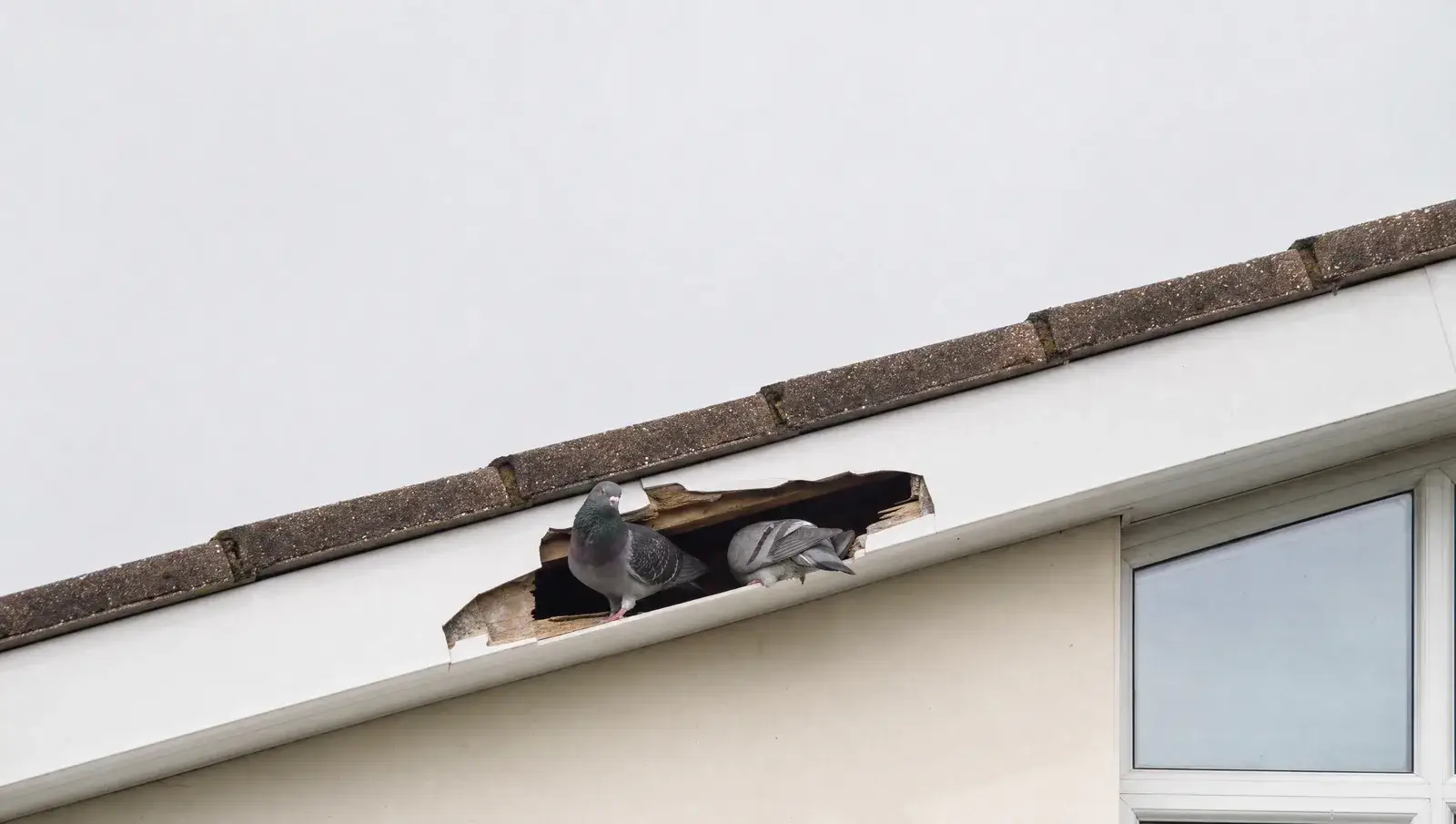
Birds and pests in your roof space
Scratching at dawn, cooing in the eaves, droppings on the insulation. How they got in, what the law allows, and the sequence that gets them out for good.
Moss and nesting debris usually travel together: see roof cleaning and moss removal costs.
How they're getting in
- Lifted or slipped tiles, especially at edges and around flashings, open gaps straight into the loft.
- Broken soffit boards and vents: rotted timber soffits and cracked vent covers are the classic pigeon and starling doorway.
- Gaps at the eaves where fascia meets the roofline, common where old boards have warped or the felt has decayed at the gutter edge, and a favourite of nesting birds, wasps and squirrels alike.
Listen and watch for a week before acting: where the birds land and disappear is the entry point, and dawn and dusk are when traffic is heaviest. Knowing every opening matters, because proofing one hole while another stays open just moves the residents along the roofline.
The legal bit: nesting birds are protected
Under the Wildlife and Countryside Act 1981, all wild birds, their eggs and their active nests are protected. Disturbing or destroying a nest that is being built or in use is an offence, and that includes pigeons in your soffit. In practice this makes timing the whole game: once the young have fledged and the nest is out of use it can be cleared and the hole proofed, and work planned outside the main nesting season (broadly spring into late summer) avoids the problem entirely. If you suspect bats rather than birds, stop and take advice first; bats and their roosts have even stricter protection.
The fix sequence
- 1. Confirm everything is out. Watch the entry points at dawn and dusk for a few days with no activity, and check the loft for sound and fresh droppings. Never seal an animal in: a blocked exit means a carcass in the roof or a chewed new hole.
- 2. Proof the entry points. Mesh, eaves combs and proper vent covers close the routes while keeping the ventilation your loft needs.
- 3. Repair the damage. Replace broken soffit and fascia boards, refit slipped tiles, clear fouled insulation and nesting debris from gutters and valleys. This is the step that stops the cycle repeating, and a general roof repair visit can usually cover proofing and repairs together.
What it costs
Because the real fix is repair work, the costs are repair costs. Soffit and fascia repairs run £60 to £120 per metre in 2026, with a full roofline replacement on a semi at £1,200 to £2,800; the breakdown is in our fascias and soffits cost guide. Refitting slipped or broken tiles costs £150 to £400 per visit, covered in the roof tile cost guide. Proofing materials added during those repairs cost little; standalone pest-control visits are extra and vary by firm.
Keeping them out
- Walk the roofline visually each spring and autumn; binoculars beat ladders.
- Keep gutters clear so damp debris does not rot the fascia behind them.
- Replace tired timber rooflines with uPVC when budget allows; there is nothing to rot.
- Deal with the first pair of pigeons promptly; established colonies are far harder to move.
Get the roofline proofed and repaired
Up to three itemised quotes from vetted local roofers for soffit, fascia and tile repairs that keep pests out. Free, no obligation.