
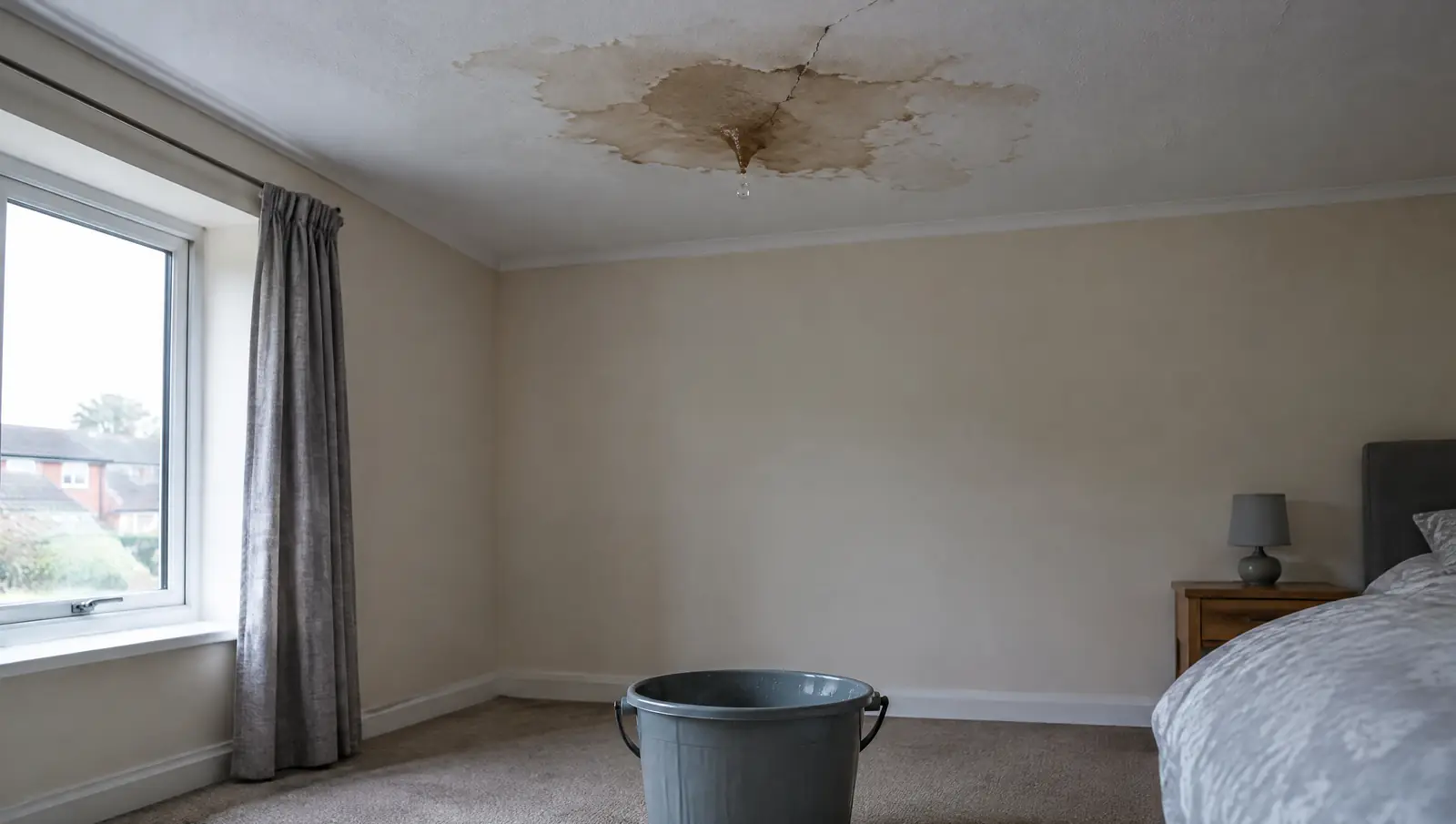
Brown water stain on the ceiling: what it means
By the time a stain shows, the water has been up there a while. The useful question is not how bad it looks, but which of three things is causing it.
Roof, plumbing or condensation
Start here, because the three have different fixes and different trades.
| Clue | Roof leak | Plumbing leak | Condensation |
|---|---|---|---|
| Timing | Appears or worsens with rain | Constant, or worse when water is used | Worse in cold weather |
| Location | Top floor only, often near a chimney, valley or wall junction | Any floor, usually under a bathroom or tank | Corners, external walls, around the loft hatch |
| Colour | Brown or tea-coloured, hard edge | Clean water mark, softer edge | Grey patches, often with black spotting |
| Smell | Damp, earthy | Little smell | Musty |
| Mould | Occasionally | Rare | Common, black speckles |
The brown colour is the giveaway on a roof leak: the water has passed through dust and timber on its way down. Clean water with no colour generally comes from a pipe.
What the stain is telling you
- A hard brown ring that is not growing. An old leak, possibly already fixed. Check the loft in daylight for daylight through the roof and for staining on the timbers, and see whether it feels damp now.
- A spreading stain after every downpour. An active leak. Our guide to roofs that leak only in heavy rain narrows down the cause.
- A sagging, heavy patch. Water is pooling above the plasterboard. Put a bucket down and pierce the centre with a screwdriver to release it in a controlled way, rather than waiting for the whole ceiling to come down.
- Yellow-brown at the light fitting. Turn the circuit off at the consumer unit before touching anything.
What to do today
- Move anything valuable and put a container underneath.
- Turn off the lighting circuit if water is anywhere near a fitting.
- Go into the loft with a torch in daylight and look for wet felt, wet timber or visible light.
- Photograph it, with the date, in case you claim.
- Call a roofer if it worsens with rain, or a plumber if it does not. Do not repaint anything yet.
What it costs to put right
| Job | Typical 2026 cost |
|---|---|
| Trace and fix a roof leak | £150 – £600 |
| Emergency make-safe, tarping | £150 – £400 |
| Stain-block and redecorate the ceiling | £150 – £300 |
| Cut out and replace a section of plasterboard | £250 – £500 |
| Replace and skim a full ceiling | £500 – £1,200 |
| Timber repairs after a long-running leak | £1,000 – £3,000 |
Do not decorate until the leak has been fixed and the plaster has dried, which takes two to four weeks. Painting over a damp ceiling traps the moisture and the stain comes back through within months. A stain blocker, not ordinary emulsion, is what stops it bleeding through the new paint.
Will insurance pay?
It depends entirely on the cause. A burst tank or pipe in the loft is escape of water and usually covered, including the ceiling. Storm damage that let water in is covered. A tile that slipped through age, or a leak that has been quietly soaking the ceiling all winter, is wear and tear and is not. Full detail is in roof leaks and home insurance, and what buildings insurance covers sets out the insured events.
When a stain means something structural
Repeated staining in the same place over years means the timber above has been wet for years. Look for a dipped ceiling line, a sagging roof above it, or springy boards in the loft. At that point the ceiling is a symptom and the survey matters more than the paint.
Find the leak before it costs more
Three free quotes from vetted local roofers. Most leak repairs are a morning's work if you catch them early.