
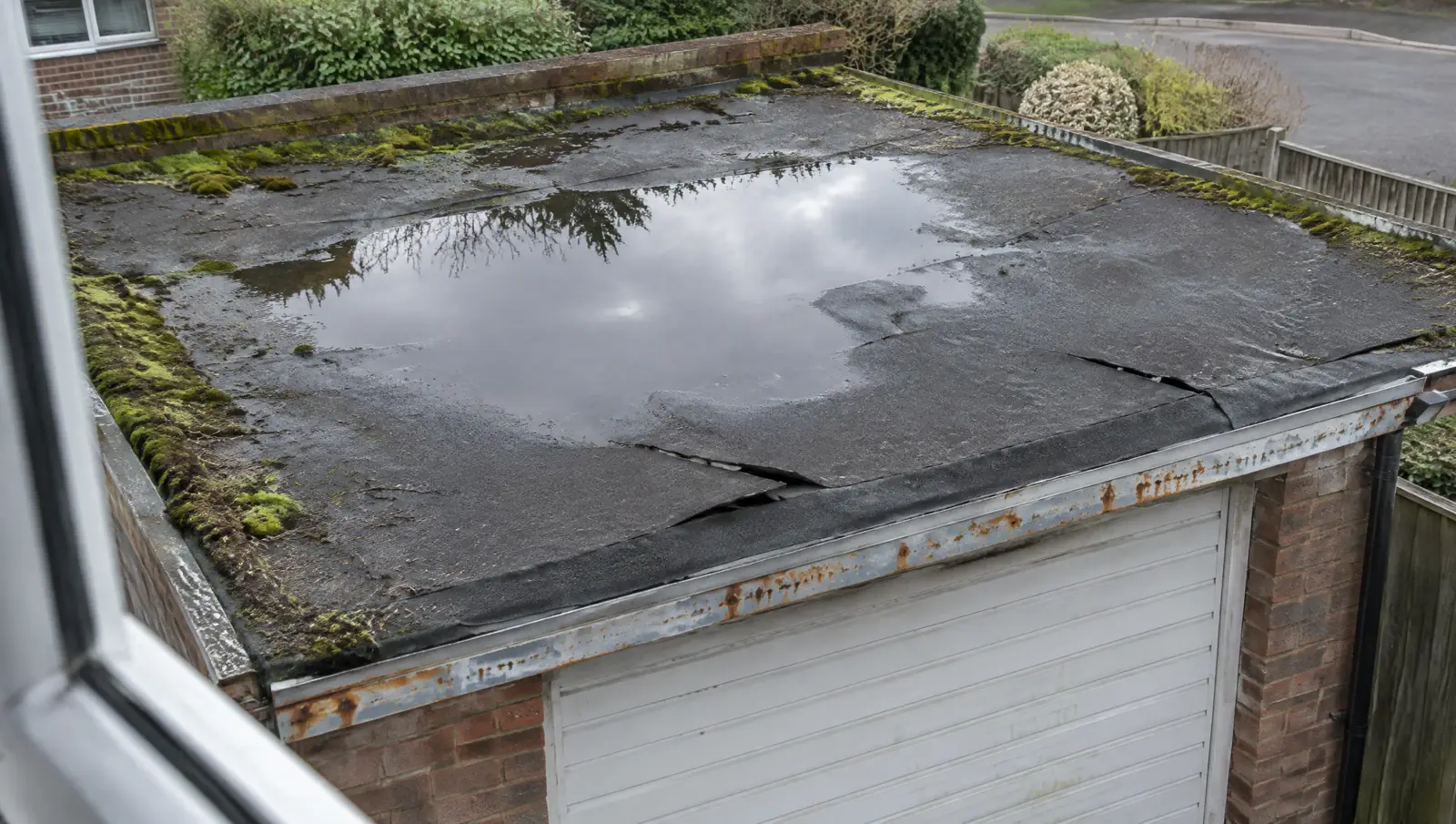
Flat roof leaks and insurance: the exclusions to check
Flat roofs are where household policies get restrictive, and where people discover the restriction at the worst possible moment.
Insurers price risk on data, and the data on flat roofs is not flattering: they fail sooner, they fail more often, and the failures are expensive because water gets into the building rather than running off it. That is why almost every household policy in the UK treats a flat roof as a condition rather than a detail.
The three conditions to check in your policy
- Percentage of total roof area. Many policies are priced on the assumption that no more than 20 to 30 per cent of your roof is flat. A large rear extension can push a house over that line without the owner noticing.
- Age of the covering. Some policies exclude or limit cover on flat roofs over 10, 15 or 20 years old. Felt is the usual target because the failure curve is steep after 15 years.
- Maintenance requirement. Wording such as "kept in a good state of repair" turns a neglected roof into an excluded one.
None of these is hidden. They sit in the policy schedule and in the statement of fact you agreed when you bought the cover.
What you have to declare
If the insurer asked, you answer accurately: the proportion of flat roof, the covering material, and its age if you know it. Declaring a flat roof rarely makes a policy unaffordable. Failing to declare one gives the insurer grounds to reduce or decline a claim later, including claims that have nothing to do with the roof. It is the cheapest risk on this page to eliminate.
When a flat roof claim does pay
| Usually covered | Usually not |
|---|---|
| Storm lifting or tearing the covering | Ponding water and the leaks it causes |
| Impact, such as a branch through the deck | Blisters, splits and perished felt |
| Fire and the water used to fight it | Failed seams at the end of a roof's life |
| Escape of water from a tank above | Damage from a covering past a policy age limit |
| Vandalism | Gradual damp in the deck and joists |
Ponding deserves its own line. Water sitting on a flat roof for more than 48 hours after rain is a design or fall problem, not an event, and no policy insures a design problem. Our ponding guide covers the fix and what it costs.
Why the deck matters more than the covering
On a flat roof, a slow leak soaks the timber deck and the joists underneath. By the time a stain appears on the ceiling the structural repair is often larger than the covering repair, and the insurer will argue it is gradual damage because it plainly is. This is the practical reason to fix a flat roof leak in the week it appears rather than the season: at £150 to £400 for a patch it is cheap, and at £1,000 to £3,000 for timber repairs it is not.
Getting a flat roof back on side
If your covering is near an age limit, replacing it solves both the leak risk and the insurance position. Give the insurer the date, the material and the guarantee.
- EPDM rubber, £90 to £130 per m², 30 to 50 years, one seamless sheet. The default for domestic flat roofs now.
- GRP fibreglass, £110 to £150 per m², 25 to 40 years, rigid and walkable.
- Torch-on felt, £80 to £110 per m², 10 to 20 years. Cheapest today, and the material most likely to trip an age exclusion tomorrow.
Full prices by roof size are in the flat roof cost guide, and the materials are compared in felt vs EPDM vs GRP.
Flat roof at the end of its life?
Get three free quotes for a replacement in felt, EPDM or GRP from vetted local roofers, and compare against the cost guides.