
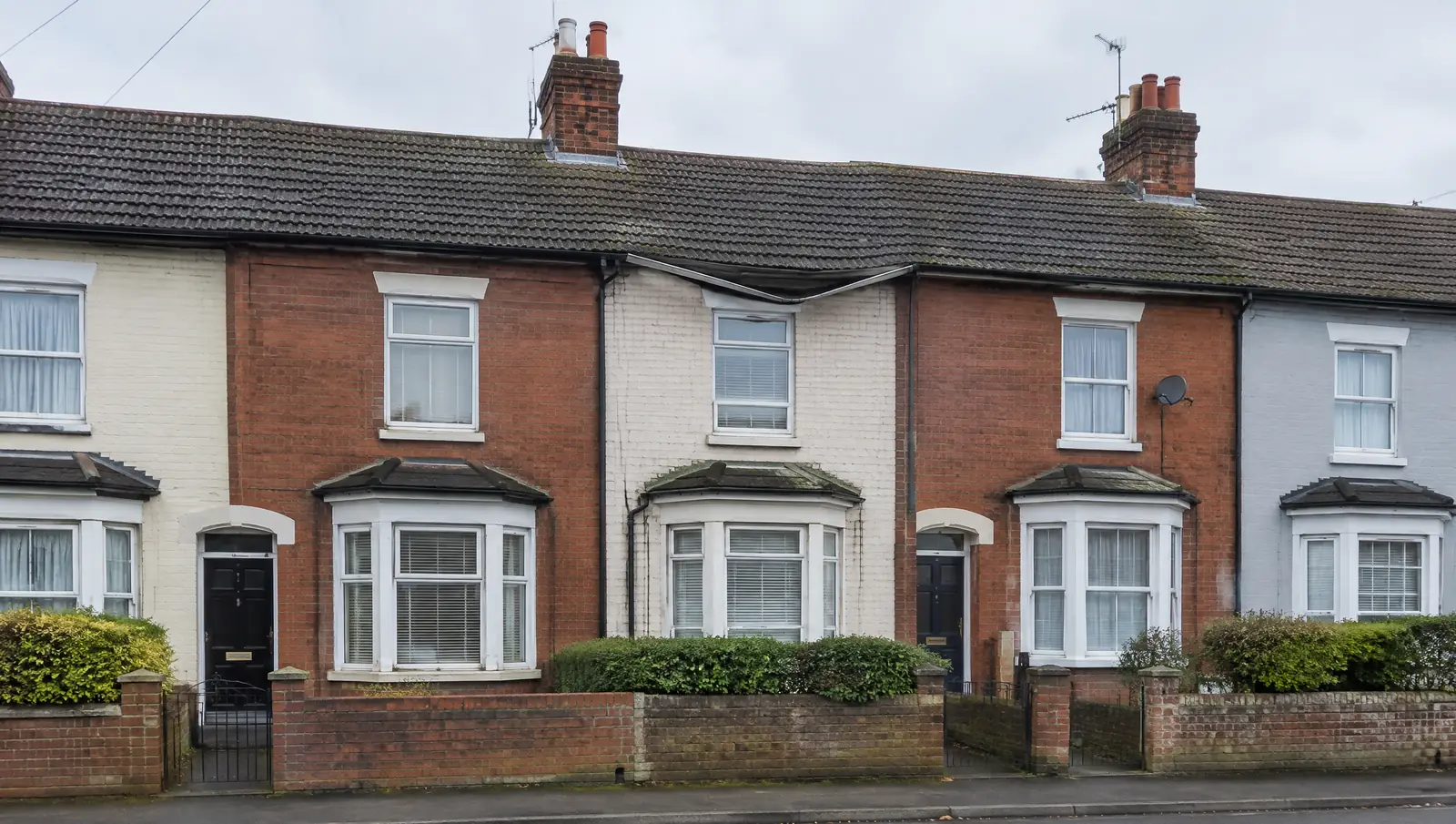
Shared gutters and party walls: who is responsible?
Terraces and semis share more roof than most owners realise, and the question only ever comes up when water is already coming in.
What is actually shared
- The party wall between two houses, including the section above the roof line and the chimney stack sitting on it.
- A valley gutter where two roofs meet, common on terraces and back additions.
- A continuous gutter run that drains both properties into one downpipe.
- A shared downpipe or drain taking water from both roofs.
Where a gutter runs along the boundary, each owner generally owns the section over their own property, and both of you rely on the whole thing working. That is why a blocked or broken section is a joint problem even where the ownership is not.
The party wall point
If the work touches a party structure, cutting into the wall, rebuilding a shared chimney stack, inserting a new flashing into a neighbour's brickwork, the Party Wall etc. Act 1996 applies in England and Wales. In practice that means:
- You serve written notice on the neighbour, typically two months before the work starts.
- They can consent, or appoint a surveyor. If surveyors are appointed, the person doing the work usually pays the fees.
- A schedule of condition before the work protects both of you from arguments afterwards.
Routine repairs on your own roof do not need a party wall notice. Rebuilding a shared stack does.
Splitting the cost
| Situation | Usual split | Typical cost |
|---|---|---|
| Shared valley gutter re-lined | 50:50 | £800 – £2,000 |
| Party wall chimney stack rebuilt | 50:50 | £1,500 – £3,500 |
| Continuous gutter run replaced | By length over each property | £600 – £1,200 |
| Blocked shared downpipe cleared | 50:50, or whoever caused it | £80 – £250 |
| Damage caused by one side's neglect | The side that neglected it | Depends on the damage |
When the neighbour will not engage
- Put it in writing. A dated letter or email describing the problem, with photographs and a written quote, is the foundation of everything that follows.
- Get a roofer's report stating the cause and which property it originates from. Ours is the sort of dispute that turns on that one sentence.
- Tell both insurers if there is damage. An insurer may pursue the neighbour directly, which takes the argument off your hands.
- Protect your own property. You can carry out work on your side, and keep the receipts. Where access to their land is genuinely necessary, the Access to Neighbouring Land Act 1992 provides a court route, though it is a last resort.
- Keep it civil. Every serious dispute here becomes a question on a future sale, and "ongoing neighbour dispute" is the answer nobody wants to write.
Leasehold flats are different
In a block or a converted house, the roof and gutters are almost always the freeholder's responsibility, paid for through the service charge. Who pays what, and what happens when the freeholder drags their feet, is covered in who pays for roof repairs in a leasehold flat.
Damage already done? When a neighbour's roof damages yours covers liability and the insurance route.
Get the job priced before the conversation
Three free quotes from vetted local roofers. A written price makes a shared-cost conversation far easier than a rough figure.